For CIS subcontractors

MTD for Income Tax for CIS subcontractors.

Deductions already taken, materials versus labour, and your usual year-end refund. Here's exactly how Making Tax Digital handles CIS if you're a self-employed subbie earning over £50,000.

The question every subbie asks

"I already have tax deducted. Why do I need to report quarterly?"

Because CIS and MTD do two different jobs. CIS is money taken off you up front. MTD is how you tell HMRC what you actually earned and spent.

Live now
Apr 2026
If your income is over £50,000
20% / 30%
CIS deducted from labour, before you're paid
4/yr
Quarterly updates, then a final declaration
How it fits together

CIS deductions and MTD, side by side.

Nothing about your CIS deductions changes. What changes is that you report your income and expenses four times a year instead of once.

What stays the same

  • Contractors still deduct 20% (or 30% if unverified) from your labour
  • Materials you supply are not subject to CIS deductions
  • The CIS already taken counts towards your tax bill
  • Overpaid through the year? You're still due a refund at year-end

What's new under MTD

  • Keep digital records of income, CIS deductions and expenses
  • Send HMRC a short quarterly update
  • File a final declaration instead of a Self Assessment return
  • Gross income Record the full value of the work
  • CIS deducted Logged against each payment, ready to offset
  • Year-end refund Reconciled in your final declaration
The subbie detail

The bits that matter on site.

Labour vs materials

CIS only applies to labour. Split labour and materials on every invoice and your deductions, and your quarterly figures, stay accurate.

Deductions you can offset

Record every CIS deduction taken from you so it's ready to set against your tax bill, no shoebox of statements needed in January.

Your usual refund

Because 20% comes off your labour all year, many subbies overpay. The final declaration reconciles it so any refund still lands.

Gross payment status

Paid gross with no deductions? You settle your tax through MTD reporting instead, with the same quarterly updates and final declaration.

Why Clear Books

CIS is built in, not bolted on.

You shouldn't need an accountant just to keep track of what's been deducted from your pay. Clear Books handles CIS for sole trader subcontractors out of the box.
  • Record CIS deductions taken from each payment
  • Split labour and materials on your invoices
  • Keep deductions ready to offset at year-end
  • Send HMRC-compliant quarterly updates in minutes
  • Snap a receipt for tools or materials on the app
  • Free plan available, no timer
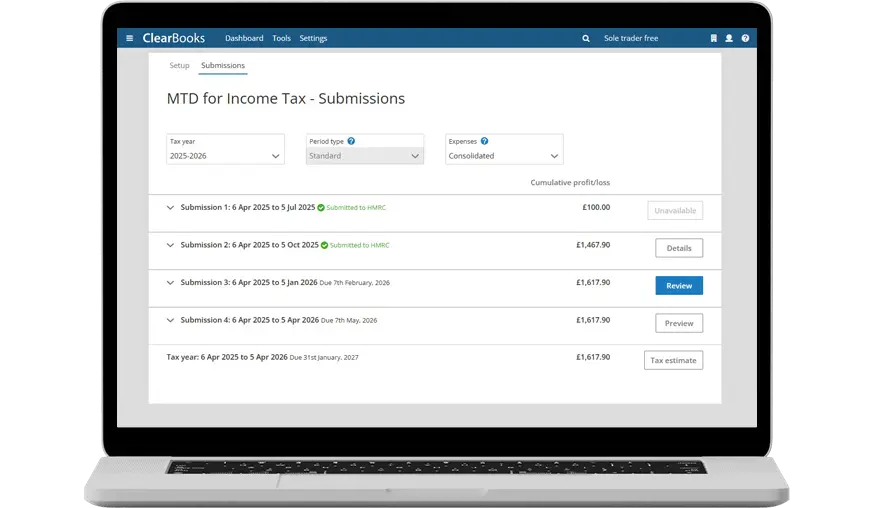
The Clear Books MTD for Income Tax submissions screen showing four quarterly updates submitted to HMRC
CIS deduction recorded
HMRC recognised
Common questions

CIS & MTD FAQ.

Does MTD change how CIS deductions work?
No. Contractors still deduct CIS from your payments at 20% (or 30% if you're not verified) before you're paid. MTD only changes how you report income and expenses, from one annual return to four quarterly updates plus a final declaration. The CIS deducted is still credited against your tax bill.
Will I still get my CIS tax refund?
Yes. Because 20% comes off your labour throughout the year, many subcontractors overpay. Your final declaration reconciles the CIS deducted against the tax you actually owe, so any refund still comes through.
Do I report gross income or the amount after CIS?
You record your gross income and the CIS deduction separately. Clear Books keeps the two linked so your quarterly figures are right and the deductions are ready to offset at year-end.
How do materials fit in?
CIS is only deducted from the labour part of your work, not materials you supply. Recording the split keeps your CIS figures accurate and your quarterly updates cleaner.
I have gross payment status, does MTD still apply?
Yes. With gross payment status no CIS is deducted, so you settle tax through your MTD reporting instead. You still keep digital records and file quarterly updates and a final declaration if you're over the threshold.
Free for sole trader subbies

Keep your CIS records HMRC-ready.

Record your payments and deductions as you go, send your first quarterly update, and make the year-end refund the easy bit.