The complete guide for the self-employed and landlords: who's in scope, the key thresholds and dates, quarterly updates and the software you'll need to stay on the right side of HMRC.
It replaces the once-a-year Self Assessment scramble with digital records and short quarterly check-ins. With the right software, most of it happens as you go.
Record your business income and expenses digitally, on the web or in the mobile app, as they happen.
Four times a year, send HMRC a short summary of your income and expenses. Usually under 10 minutes.
At year-end, confirm your figures and any other income in one final declaration. This replaces your old Self Assessment return.
Your tax and payment dates don't change. MTD changes how you report, not when you pay.
MTD for Income Tax is phased in by income. HMRC adds up your gross income from self-employment and property before expenses, then compares the total to the threshold for the year.
If you're under the threshold you can carry on with annual Self Assessment for now, but keeping tidy digital records means you're ready when the next step lands.
See plans & get started →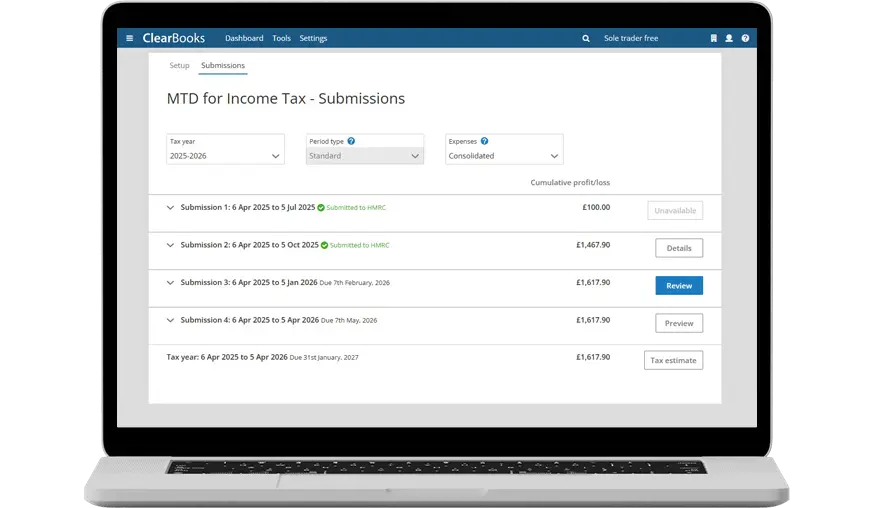
The threshold steps down each year. Find the line you cross.
Mandatory for sole traders and landlords with gross income over £50,000. If that's you, it applies now.
Threshold drops to £30,000.
Threshold drops to £20,000.
Every trade and income type has its own quirks. Start with the guide built around how you actually earn.
Property income, multiple lets, jointly-owned property and the mortgage interest rules under MTD.
Read the guide →How CIS deductions, materials and your usual tax refund work once you're reporting quarterly.
Read the guide →Van, tools and materials, certification records and a mix of domestic and contract work.
Read the guide →Emergency call-outs, cash jobs, materials markup and the Gas Safe overlap.
Read the guide →Gas Safe costs, boiler installs versus service calls and winter income spikes.
Read the guide →CIS both ways, deposits, staged payments and a materials float.
Read the guide →Workshop and site work, timber, bespoke commissions with deposits and tools.
Read the guide →Seasonal income, scaffolding hire, insurance work and plenty of cash jobs.
Read the guide →Day rate versus price work, CIS deductions and simple sole-trader records.
Read the guide →Mostly CIS day and price rates, minimal materials, PPE and tools.
Read the guide →Big material orders passed to clients, deposits, other trades and cash flow.
Read the guide →Equipment as a capital asset, almost all CIS, inspection and insurance costs.
Read the guide →F-Gas certification, recurring service contracts, install materials and summer demand.
Read the guide →Private and locum work, clinic room rent, insurer billing and HCPC fees.
Read the guide →Clinic ownership or associate room rent, GOsC fees and insurer billing.
Read the guide →Associate room rent, equipment assets, GCC fees and care-plan income timing.
Read the guide →Day rates across pharmacies, agency versus direct, mileage and GPhC fees.
Read the guide →Sessional income across practices, indemnity, GMC fees and pensions kept separate.
Read the guide →Associate percentages of UDA and private work, lab fees, GDC fees and materials.
Read the guide →High-value treatments, product stock, clinic room rent, insurance and training.
Read the guide →Fleet training day rates, an expensive training vehicle, DVSA fees and B2B invoicing.
Read the guide →High gross fares, the vehicle expense decision, plate, licence and circuit fees.
Read the guide →Operator fees, licensing, DBS and the vehicle expense method that suits you.
Read the guide →Platform fees, HMRC getting your earnings direct, and multi-apping across platforms.
Read the guide →Owner-driver contracts, per-drop pay, high mileage and van finance.
Read the guide →Route and franchise fees, van lease and self-billing invoices as records.
Read the guide →Very high turnover, big running costs, truck finance and the O-licence.
Read the guide →Materials versus labour, domestic cash jobs and a seasonal diary.
Read the guide →Materials-heavy jobs, deposits and a domestic plus contract mix.
Read the guide →Seasonal peaks, plant hire, green-waste disposal and maintenance retainers.
Read the guide →Materials markup, offcuts and showroom subcontracting.
Read the guide →Large orders, deposits, FENSA costs and emergency glazing.
Read the guide →Heavy materials, plant hire, deposits and weather-driven work.
Read the guide →Scheme-funded work, guarantees and the survey versus install split.
Read the guide →Many small cash jobs, minimal materials and landlord retainers.
Read the guide →Rent a chair, room or space? For MTD, you're self-employed.
Read the guide →Gym floor rent, session income and online programmes.
Read the guide →Per-class pay across gyms and mileage between venues.
Read the guide →Subscription income, platform fees and overseas clients.
Read the guide →Membership income, hall hire or dojo rent, and gradings.
Read the guide →Room hire or online, sliding-scale fees and supervision.
Read the guide →Clinic and home visits, HCPC fees and domiciliary mileage.
Read the guide →Programme packages, online delivery and affiliate income.
Read the guide →Room rent, needles and consumables, and session packs.
Read the guide →Agency and direct clients, live-in and hourly work, and mileage.
Read the guide →Chair rent, colour stock, cash tips and retail sales.
Read the guide →Chair rent, a heavy cash trade and high walk-in volume.
Read the guide →Room rent, treatment packages, product stock and vouchers.
Read the guide →Bridal and event bookings, deposits and a kit that's a big cost.
Read the guide →High-value treatments, top-up appointments and training income.
Read the guide →Studio rent, deposits, cash takings and guest spots.
Read the guide →Franchise fees, the dual-control car and block-booked lessons.
Read the guide →The weekly franchise fee and a car leased through the franchise.
Read the guide →No franchise fee, your own car finance and advertising.
Read the guide →An executive vehicle, account invoicing and waiting time.
Read the guide →The van, helper wages and a platform plus cash mix.
Read the guide →School runs, charters, PSV and O-licence costs.
Read the guide →A specialist vehicle, bespoke insurance and per-job quoting.
Read the guide →D1 and D category training, a specialist vehicle and course income.
Read the guide →NHS and care contracts, an accessible vehicle and mileage.
Read the guide →Studio hire, retreats, online classes and teacher training.
Read the guide →Reformer equipment, studio rent and class packs sold upfront.
Read the guide →Per-session and club pay, holiday camps and DBS costs.
Read the guide →Pool hire, block-booked lessons and seasonal peaks.
Read the guide →Studio and hall hire, term fees, showcases and costumes.
Read the guide →Per-class pay across venues, mileage and music licensing.
Read the guide →Room rent or mobile, cash and card, oils and vouchers.
Read the guide →Room rent or mobile, cash-heavy and low overheads.
Read the guide →No premises, mileage as the key cost and home-visit cash.
Read the guide →Table rent or home studio, consumables and infill bookings.
Read the guide →Room rent or home studio, consumables and the infill model.
Read the guide →Often a second income, low overheads and cash and card.
Read the guide →Mobile and home work, consumables and seasonal peaks.
Read the guide →Room rent or mobile, low material cost and high repeat frequency.
Read the guide →A fleet of training bikes, CBT block bookings and summer peaks.
Read the guide →Bike or car, a huge gross-to-profit gap and multi-app income.
Read the guide →No guide for that yet. More trade and sector guides are on the way, ask our MTD assistant in the meantime.
More trade and sector guides are on the way.
Grab the free plan or move up to a paid plan and you'll be set up and submitting in under 15 minutes.
