For self-employed plasterers

MTD for Income Tax for plasterers.

Day rate and price work, frequent CIS subcontracting, materials and the odd cash job. Here's how Making Tax Digital for Income Tax applies to plasterers, kept as simple as your record-keeping should be.

Does this apply to me?

If you turn over more than £50,000, it applies now.

MTD for Income Tax is measured on gross income before expenses. If you're on good day rates or plenty of price work, you can cross £50,000 without a big materials bill.

Live now
£50,000
Gross income from April 2026
£30,000
Threshold from April 2027
£20,000
Threshold from April 2028
Mostly on CIS?

CIS and MTD do two different jobs.

If most of your work has CIS deducted, that hasn't changed. MTD is simply how you report your income and expenses each quarter. You record the gross and the CIS deducted, and it reconciles at year-end, often as your usual refund.

See the CIS guide
What's changing

Digital records, four quarterly updates, one final declaration.

Your annual Self Assessment return is replaced by four short quarterly updates and a year-end final declaration, all through recognised software.

Expenses to keep digital

  • Plaster, beading and materials
  • Mixers, tools and consumables
  • Van, fuel and running costs
  • PPE and workwear
  • Any tool or access hire
  • Public liability insurance

Log CIS deductions as they're taken so your year-end refund is ready to reconcile without a shoebox of statements.

  • CIS deducted Recorded, ready to offset your tax
  • Day rate vs price work Both totalled into one update
  • Light on materials Simple, tidy sole-trader records
The plastering detail

The bits specific to your trade.

CIS deductions

Most plasterers are on CIS. Record what's deducted so your usual refund is ready to reconcile at year-end.

Day rate vs price work

However you're paid, it's income in the quarter it happens. Clear Books totals both so you just review and submit.

Materials and tools

Plaster, beading, mixers and tools are all deductible. Snap the receipts and your expense total stays complete.

Simple by design

Light on materials means simple records. A few taps per job keeps you compliant without the admin creeping up.

Why Clear Books

CIS built in, MTD made simple.

You want tidy records without the faff. Clear Books handles CIS for subcontractors and gives HMRC exactly what MTD requires.
  • Record CIS deducted from each payment
  • Keep day-rate and price-work income in one place
  • Snap materials and tool receipts on the app
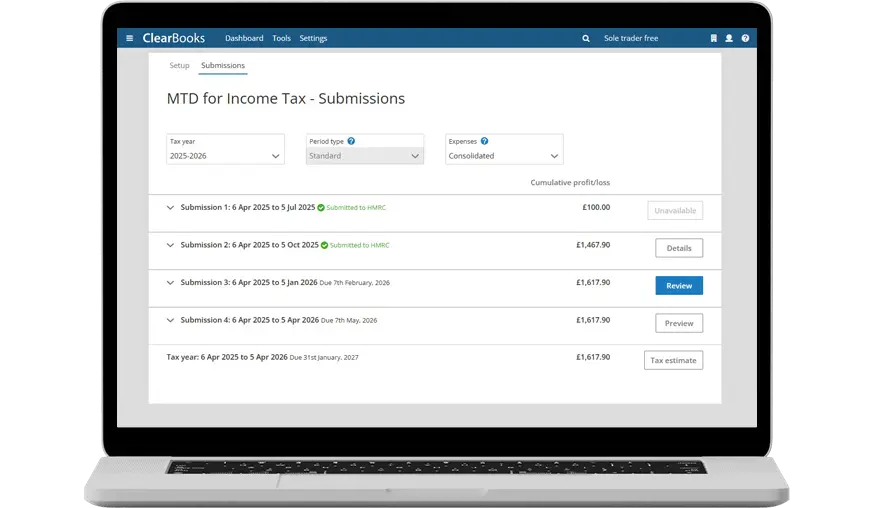
  • Send HMRC-compliant quarterly updates in minutes
  • Year-end refund ready to reconcile
  • Free plan available, no timer
The Clear Books MTD for Income Tax submissions screen showing four quarterly updates submitted to HMRC
CIS deduction recorded
HMRC recognised
Common questions

Plasterer MTD FAQ.

Do plasterers have to use MTD for Income Tax?
Yes, if you're a self-employed plasterer with gross income over £50,000, it applies from 6 April 2026. The threshold drops to £30,000 from April 2027 and £20,000 from April 2028.
I'm on CIS most of the time, does MTD still apply?
Yes. CIS is money deducted from your labour up front; MTD is how you report income and expenses each quarter. You record the gross and the CIS deducted, and it reconciles at year-end, often as a refund.
Day rate or price work, does it matter for MTD?
No. However you're paid, it's income recorded in the quarter it happens. Clear Books totals it so you just review and submit.
What can I claim as a plasterer?
Typical costs include plaster, beading and materials, mixers and tools, your van and fuel, PPE and workwear.
How do I record cash jobs?
Cash jobs are taxable income and must be in your digital records. Log the payment in the app when you're paid so nothing is missed at quarter-end.
Free for sole trader plasterers

Keep it simple, keep it compliant.

Log your jobs and CIS as you go, and send your first quarterly update in minutes.