For self-employed bricklayers

MTD for Income Tax for bricklayers.

Almost always on CIS, paid day or price rates, light on materials but heavy on graft. Here's how Making Tax Digital for Income Tax applies to bricklayers, and when it starts for you.

Does this apply to me?

If you turn over more than £50,000, it applies now.

MTD for Income Tax is measured on gross income before expenses. On steady day rates, a full year of bricklaying can clear £50,000 on labour alone.

Live now
£50,000
Gross income from April 2026
£30,000
Threshold from April 2027
£20,000
Threshold from April 2028
CIS every week

Your deductions are the whole story.

Nearly all your income has 20% taken at source. MTD does not change that. It's how you report your income and the CIS deducted each quarter, so your year-end refund reconciles without a drawer full of statements.

See the CIS guide
What's changing

Digital records, four quarterly updates, one final declaration.

Your annual Self Assessment return is replaced by four short quarterly updates and a year-end final declaration, all through recognised software.

What to keep digital

  • Gross income per payment, before CIS
  • CIS deducted from each payment
  • PPE, workwear and boots
  • Trowels, tools and lines
  • Travel and van costs to sites
  • Any protective or lifting equipment

The key record for a bricklayer is CIS deducted. Log it as you're paid and your refund is ready to reconcile.

  • CIS at 20% Taken from labour before you're paid
  • Day and price rates Totalled into one quarterly update
  • Year-end refund Reconciled in your final declaration
The bricklaying detail

The bits specific to your trade.

CIS is the main record

With most work on CIS, recording deductions accurately is what makes your year-end refund quick and correct.

Your usual refund

Deducted at 20% all year, many brickies overpay. The final declaration reconciles it so any refund still lands.

PPE and tools

Boots, gloves, trowels and lines are deductible. Small costs add up, so keep them logged.

Multiple sites

Worked three sites this quarter? It all rolls into one update. No need to report each one separately.

Why Clear Books

CIS built in, MTD made simple.

You want the refund without the headache. Clear Books records your CIS as you go and gives HMRC exactly what MTD requires.
  • Record CIS deducted from each payment
  • Keep gross income logged, ready to reconcile
  • Snap receipts for PPE and tools on the app
  • Send HMRC-compliant quarterly updates in minutes
  • Year-end refund ready at final declaration
  • Free plan available, no timer
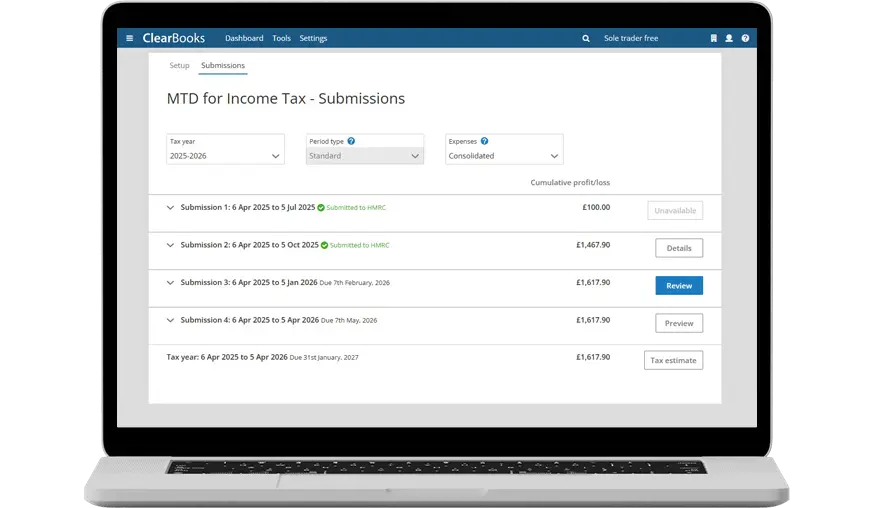
The Clear Books MTD for Income Tax submissions screen showing four quarterly updates submitted to HMRC
CIS deduction recorded
HMRC recognised
Common questions

Bricklayer MTD FAQ.

Do bricklayers have to use MTD for Income Tax?
Yes, if you're a self-employed bricklayer with gross income over £50,000, it applies from 6 April 2026. The threshold drops to £30,000 from April 2027 and £20,000 from April 2028.
Almost all my work is CIS, does MTD still apply?
Yes. CIS is deducted from your labour before you're paid; MTD is how you report income and expenses each quarter. You record the gross and the CIS deducted, which reconciles at year-end, usually as a refund.
Will I still get my CIS refund under MTD?
Yes. Because 20% comes off your labour all year, many bricklayers overpay. Your final declaration reconciles the CIS deducted against the tax you owe, so any refund still comes through.
What can I claim with so few materials?
Even on labour-only work you can usually claim PPE and workwear, tools, travel to sites and protective equipment. Keeping these recorded reduces your taxable profit.
Do I report each site separately?
No. Your quarterly update summarises your total income and expenses across all the sites you've worked. Clear Books totals it so you just review and submit.
Free for sole trader bricklayers

Make the refund the easy bit.

Log your pay and CIS deductions as you go, and send your first quarterly update in minutes.