For self-employed courier drivers

MTD for Income Tax for courier & multi-drop drivers.

Owner-driver contracts, per-drop pay, high fuel and mileage and van finance. Here's how Making Tax Digital for Income Tax applies to courier and multi-drop drivers, and when it starts.

Does this apply to me?

Gross pay, not take-home, decides it.

MTD for Income Tax is measured on gross income before costs. With high mileage and a van to run, your gross pay is a long way above your profit.

Live now
£50,000
Gross pay from April 2026
£30,000
Threshold from April 2027
£20,000
Threshold from April 2028
The van eats the difference

High mileage means a big gap.

Fuel, tyres and van finance take a big bite out of courier pay, so your gross is much higher than your take-home. Since MTD tests the gross figure, it's worth checking where you stand.

What records you need
What's changing

Digital records, four quarterly updates, one final declaration.

Your annual Self Assessment return is replaced by four short quarterly updates and a year-end final declaration, all through recognised software.

What to keep digital

  • Per-drop or per-route pay
  • Fuel, or mileage if you use the flat rate
  • Van insurance and finance
  • Parking and tolls
  • Phone and data
  • Any equipment or handhelds

Your weekly pay statements make good records; bring them in so your quarterly income is complete.

  • Per-drop pay Totalled across the quarter
  • High mileage Vehicle method really matters
  • Van finance Handled by your chosen method
The courier detail

The bits specific to courier work.

Vehicle method matters most

With high mileage, the flat rate versus actual costs decision has a real impact. Compare both and keep the records.

Per-drop pay

Pay per drop or route is income recorded as you're paid. Weekly statements total it for the quarter.

Van finance and insurance

Both are significant. How you claim them depends on your vehicle expense method, so keep the paperwork.

Parking, tolls and phone

The small stuff adds up across a busy round. Snap receipts so nothing is left out.

Why Clear Books

Built for the round, not the office.

Between drops is no time for spreadsheets. Clear Books lets you keep records from your phone and gives HMRC exactly what MTD requires.
  • Bring in weekly pay statements
  • Track your chosen vehicle expense method
  • Keep van finance and insurance recorded
  • Snap parking, toll and phone receipts
  • Send HMRC-compliant quarterly updates in minutes
  • Free plan available, no timer
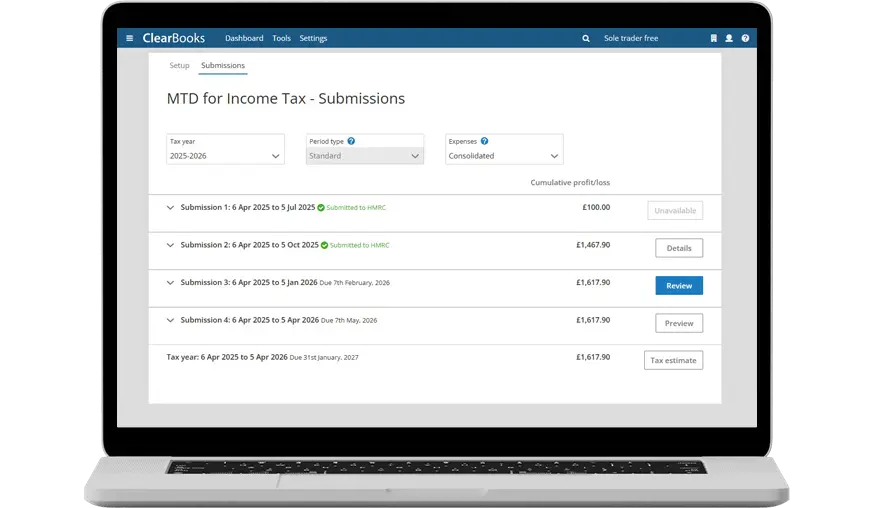
The Clear Books MTD for Income Tax submissions screen showing four quarterly updates submitted to HMRC
Q1 update submitted
HMRC recognised
Common questions

Courier driver MTD FAQ.

Do courier and multi-drop drivers have to use MTD for Income Tax?
If your gross income is over £50,000, it applies from 6 April 2026. With high mileage and van costs, gross pay is well above take-home, so many couriers are in scope. It drops to £30,000 from April 2027 and £20,000 from April 2028.
How do I record per-drop pay?
Per-drop or per-route pay is income you record as you're paid, usually from a weekly statement. Clear Books totals it across the quarter so your gross income is complete.
Which vehicle expense method suits couriers?
You can claim a flat rate per mile or actual running costs plus capital allowances on the van. High-mileage couriers should compare both; your accountant can help. It's usually one or the other for a vehicle.
Can I claim van finance and insurance?
If you claim actual costs, van finance is dealt with through capital allowances and interest, and insurance is deductible. If you use the mileage flat rate, that rate already covers running costs.
What else can I claim?
Typical costs include fuel or mileage, van insurance and finance, parking, tolls, phone and any equipment.
Free for self-employed couriers

Keep your round and your books moving.

Bring in your pay and log your costs as you go, and send your first quarterly update in minutes.