For self-employed builders

MTD for Income Tax for builders.

CIS as both contractor and subcontractor, project deposits, staged payments and a materials float. Here's how Making Tax Digital for Income Tax applies to builders, and when it starts for you.

Does this apply to me?

If you turn over more than £50,000, it applies now.

MTD for Income Tax is measured on gross income before expenses. With materials and subcontractor costs passing through your accounts, most builders are well over the line.

Live now
£50,000
Gross income from April 2026
£30,000
Threshold from April 2027
£20,000
Threshold from April 2028
CIS both ways

Contractor and subcontractor at the same time.

Many builders deduct CIS from the subbies they pay while having CIS deducted from them on other jobs. MTD does not change any of that. It sits alongside CIS as the way you report your own income and expenses each quarter.

See the CIS guide
What's changing

Digital records, four quarterly updates, one final declaration.

Your annual Self Assessment return is replaced by four short quarterly updates and a year-end final declaration, all through recognised software.

Expenses to keep digital

  • Materials and merchant purchases
  • Payments to subcontractors
  • Plant, access and tool hire
  • Van, fuel and site running costs
  • Public liability and contract works insurance
  • Tools and equipment

Log deposits and staged payments as they land so each quarter reflects the real cash coming in and going out.

  • CIS as contractor Monthly CIS returns continue as normal
  • CIS as subcontractor Deductions from you offset your tax bill
  • Staged payments Recorded in the quarter they happen
The builder detail

The bits specific to your trade.

CIS both ways

Deducting from subbies and having CIS deducted from you can both apply. Keep both recorded so nothing is double counted.

Deposits and stage payments

Record income as it is invoiced or received so a deposit sits in the right quarter, with the matching materials as an expense.

Materials float

Buying materials up front is normal. Recorded as expenses, they offset the income when the job invoices, so your profit stays true.

Plant and hire

Access towers, mixers and tool hire are deductible. Snap the hire invoices so they land against the right project.

Why Clear Books

CIS built in, MTD made simple.

You already juggle CIS both ways. Clear Books keeps your own income reporting tidy on top, and gives HMRC exactly what MTD requires.
  • Record CIS deducted from you, ready to offset
  • Keep subcontractor payments and materials logged
  • Log deposits and staged payments as they land
  • Send HMRC-compliant quarterly updates in minutes
  • Snap merchant and hire receipts on the app
  • Free plan available, no timer
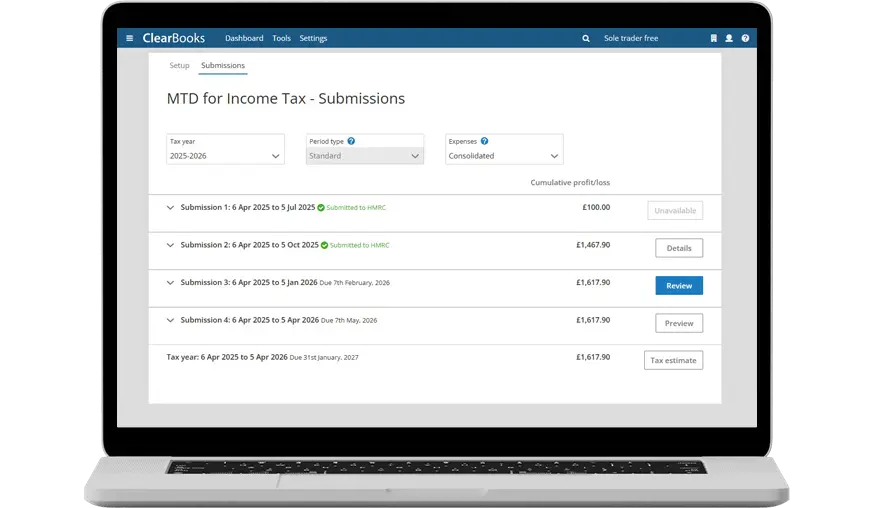
The Clear Books MTD for Income Tax submissions screen showing four quarterly updates submitted to HMRC
Q1 update submitted
HMRC recognised
Common questions

Builder MTD FAQ.

Do builders have to use MTD for Income Tax?
Yes, if you're a self-employed builder with gross income over £50,000, it applies from 6 April 2026. The threshold drops to £30,000 from April 2027 and £20,000 from April 2028.
I use subcontractors and also work as one, how does CIS fit?
You can be a CIS contractor and a subcontractor at the same time. MTD is separate: it's how you report your own income and expenses each quarter. Deductions taken from you still count towards your tax bill.
How do deposits and staged payments work?
You record income when you invoice or receive it, so a deposit or stage payment lands in that quarter. A big materials purchase in the same period is an expense, so the profit picture stays accurate.
What can I claim as a builder?
Typical costs include materials, plant and tool hire, payments to subcontractors, your van and fuel, insurance, tools and site costs.
Do I still file CIS returns as well as MTD?
If you pay subcontractors, your monthly CIS returns continue as normal. MTD for Income Tax is a separate obligation covering your own income reporting, and Clear Books keeps both tidy.
Free for sole trader builders

Keep the job and the books moving.

Record materials, subbies and stage payments as you go, and send your first quarterly update in minutes.