For self-employed osteopaths

MTD for Income Tax for osteopaths.

Whether you own a clinic or work as an associate paying room rent, here's how Making Tax Digital for Income Tax affects osteopaths, what to record and when it starts for you.

Does this apply to me?

Established osteopaths are largely in scope now.

MTD for Income Tax is measured on gross self-employed income before expenses. A full clinic diary usually puts osteopaths over £50,000.

Live now
£50,000
Gross income from April 2026
£30,000
Threshold from April 2027
£20,000
Threshold from April 2028
Associate or clinic owner?

The rent you pay is the rent you claim.

As an associate, your treatment income is yours and the room rent or percentage you pay the clinic is a deductible expense. Recording both is what keeps your quarterly figures showing the real margin, not the gross takings.

What records you need
What's changing

Digital records, four quarterly updates, one final declaration.

Your annual Self Assessment return is replaced by four short quarterly updates and a year-end final declaration, all through recognised software.

Expenses to keep digital

  • Room rent or clinic running costs
  • GOsC registration
  • Professional indemnity insurance
  • CPD, courses and training
  • Treatment equipment and consumables
  • Professional body membership

Record income as you invoice, so insurer-billed sessions land in the right quarter even when paid later.

  • Associate rent Deductible against your income
  • Clinic owner Running costs in your records
  • GOsC and indemnity Recorded as business costs
The practice detail

The bits specific to osteopathy.

Room rent model

Rent or a percentage to the clinic is deductible. Record it against your income so the margin is clear.

Clinic ownership

Running your own clinic? Rent, staff and utilities are recorded costs, offsetting the income you bring in.

GOsC and indemnity

Registration and indemnity are deductible. Keep them recorded so nothing is missed at year-end.

Insurer billing timing

Insurer-paid sessions can settle later. Recording income when invoiced keeps each quarter accurate.

Why Clear Books

Records that respect your time and your patients.

You'd rather be treating than doing books. Clear Books keeps your income and costs tidy and gives HMRC exactly what MTD requires.
  • Record clinic and associate income in one place
  • Track room rent, GOsC and indemnity costs
  • Log income as invoiced, whoever pays
  • Send HMRC-compliant quarterly updates in minutes
  • Web and mobile, so records fit around clinics
  • Free plan available, no timer
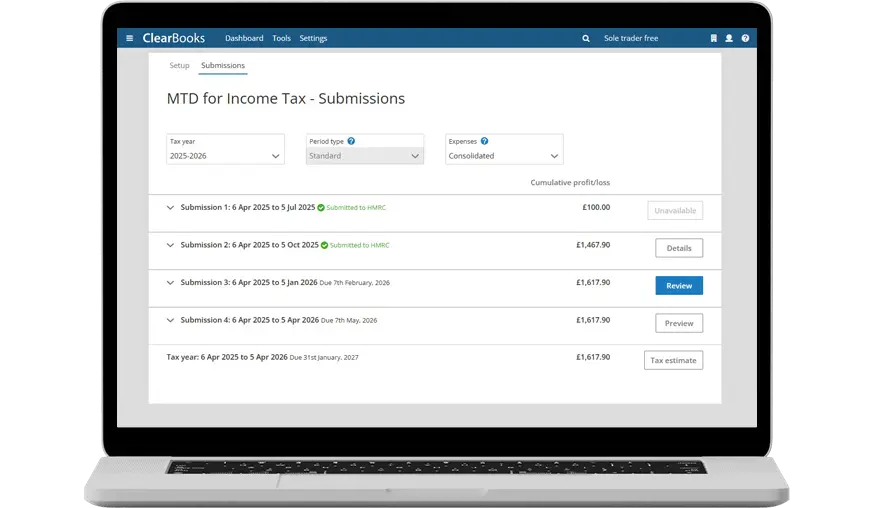
The Clear Books MTD for Income Tax submissions screen showing four quarterly updates submitted to HMRC
Q1 update submitted
HMRC recognised
Common questions

Osteopath MTD FAQ.

Do osteopaths have to use MTD for Income Tax?
If your self-employed income is over £50,000, it applies from 6 April 2026. Many established osteopaths are above that. The threshold drops to £30,000 from April 2027 and £20,000 from April 2028.
I'm an associate paying room rent, how does that work?
Your treatment income is yours and the room rent or percentage you pay the clinic is a deductible expense. Record both so your quarterly figures show the real margin.
I own my clinic, what changes?
Your income and clinic running costs, rent, staff and utilities, all sit in your records. MTD is simply how you report that income and those expenses each quarter.
Is my GOsC registration deductible?
Yes. General Osteopathic Council registration is a business cost, as is your professional indemnity insurance. Record them digitally with your other expenses.
What else can I claim?
Typical costs include room rent, GOsC registration, indemnity insurance, CPD and training, treatment equipment and consumables.
Free for self-employed osteopaths

Keep your practice records clinic-ready.

Record sessions, room rent and professional costs as you go, and send your first quarterly update in minutes.